




Forgive Him First
The one un-smiling face in the room is the detective's own, and he says a story like this plays like a happy ending only if you never run it backward — so he's going to run it backward.
Pinned to the Corkboard and will not be contradicted by a later case.
Closed for good. The dead stay dead, and the canon is append-only.
Segment one · Run It Backward
The reception room of the settlement house sat at about ninety degrees that afternoon, and not one of the six electric fans could push the air far enough to matter. Fresh paint and lemon oil, and a hundred people buttoned into their good collars — every one of them sweating, every one of them forgiving. And every last face in the hall was turned the same direction, toward the humble man in shirtsleeves they had come to take in. Toward Merrit Vane.
Forgive me, I'm — I'm no good at speeches. So I'll just say thank you. To every one of you. You took in a stranger with a hard past, and you set a place at the table for him, and you asked me for nothing. I don't have the words. I only have the rest of my life, and I mean to spend it earning the chair.
They clapped like the heat had never once touched them. And why not. A reformed man is the sweetest thing a hard year can hand a crowd — living proof the world might still give somebody back to himself. So they loved him for it, and Merrit Vane stood there in his shirtsleeves and let them, humble as a Sunday.
I keep thinking of Mr. Crane, God rest him. He kept the accounts for the house — who wanted for a coat, who wanted for a meal. He can't be with us today, and that's a hard thing to lay on a happy one. I'd have wanted him to see the hall this full.
An hour before the lemonade, two officers had walked a woman out the side door, her hands folded in front of her like she was headed in to pray. She had killed a man for this exact room — this applause, this mercy. And not one soul in it knew her name.
And you, mister. They tell me you're the one who found the truth of the thing. I owe you my thanks along with the rest of them. Maybe now the house can rest easy.
Don't thank me yet, Mr. Vane. I'm not finished reading it.
I was the only face in that hall not wearing a smile, and I knew it, and I let them see it on me. The welcome program was folded in my coat — gilt letters, the guest of honor's name printed clean across the top. By then I knew that name three different ways, and not one of them belonged in a room this kind.
Told straight ahead — a stranger arrives, the house opens its arms, the killer's caught, the curtain drops — it plays like a happy ending. It only plays that way if you never once run it backward. So that's what I'm going to do. I'm going to walk it home in reverse, all the way to the bottom, where a happy ending like this one keeps something ugly folded up in its pocket.
Segment two · A Good Man
You can write it down plain, mister. I killed Aldous Crane. Nobody helped me, nobody sent me. I did it with my own two hands and I slept fine after.
The little holding room off the settlement house was hot as a closed oven, and Neva Dunmore sat in the middle of it like a woman waiting for a streetcar. Plain gray dress, hands folded, a Bible-club calm on her that the heat couldn't touch. I'd taken a hundred confessions. They came out crying, or lying, or bargaining. She just came out clean.
Slow it down, Miss Dunmore. A man's dead. You walk me through it, or the county writes the story for you, and the county's got no imagination.
There's nothing to slow. Crane kept the almoner's ledgers here. Charity, alms, the good works — that was the face of him. Underneath he was a snake, and he'd found a soul in this house he meant to swallow whole.
A snake in a charity house. That's a new one on me. Most snakes I meet keep worse company.
You don't understand yet. There's a man in this world who fell as far as a man can fall, and clawed his way back up to the light. Years of it. Honest years. And Crane was going to stand at the door and shout the old sins in his face just when he'd finally gotten clean.
She said clean like it was a sacrament. Somewhere past the wall an electric fan turned the same dead air over and over, and the whole room smelled of fresh paint and lemon oil — a place scrubbed for a new beginning. She was glowing in it. Not sweat. Something closer to grace, and grace in a murder confession is a thing that puts the hair up on your neck.
So you did his penance for him. With a dead man on the floor. That how the arithmetic works in your church?
Crane wasn't going to forgive him. He was going to ruin him — put it in the record, in every ear, tear down everything the man had built to be good again. Somebody had to stand between them. I was the one standing there.
This good man. Give me the name, Miss Dunmore. He's the whole case now, whether you like it or not.
No. His name stays out of my mouth. That's the last thing I've got left to give him, and I'll give it. He doesn't even know what I did — he'd have stopped me, that's the kind of man he is now.
You're going to do the years alone, then. All of them. For a name you won't say.
Every year they give me. He's worth every one, mister. You'd see it too, if you'd sat where I sat and watched a soul come back from the dead.
And there it was. A killer who wanted the cell, a confession that tied itself in a bow, a victim nobody in that house would miss. I closed the notebook and felt the case shut clean in my hands — the neatest thing I'd held all summer. It never once occurred to me to ask the only question that mattered. Not who she killed. Who she was protecting, and what he'd done to be forgiven.
Segment three · Crane's Last Rounds
The day before they welcomed him, the settlement house sat under a heat that pressed on you like a hand. I walked the almoner's last rounds, room by room, following a dead man through a place that smelled of fresh paint and lemon oil. Aldous Crane had kept the accounts here. Now somebody else was keeping the account of him.
Mind the loose board there, mister. Let me get you a glass of water. In this heat a man forgets he's thirsty until he's already gone under. Merrit Vane. I do what small things they'll let me do around here.
Obliged. You knew Crane, then. The man kept the books for this house and wound up on a slab. I'm walking where he walked. You walk it with me.
I knew him the way you know a man who counts your bread. Righteous fellow. Careful. But careful men have their own troubles, and Crane had money worries, mister, the kind that turn a careful man mean. I'd hate for the good name of this house to hang on what a desperate man was reaching for.
Reaching for. That's a soft word. Say what you mean, Vane.
A blackmailer. There, I've said it and I'm sorry for it. A man that hard up, holding other men's secrets in a book? He was squeezing somebody in this house. That's the road you'll want, mister. Not the good work we do here.
He had the word ready before I'd finished the question. Blackmailer, tied up neat with a ribbon and handed to me across a glass of warm water. A penitent man is supposed to be slow to judge the dead. This one was quick, and quickness in a slow man is the one thing you notice.
Crane's desk stood in the corner room where the fan didn't reach. His book was in the drawer, right where a careful man leaves a careful thing. I turned the pages looking for the squeeze, the sums, the names with a price hung off them.
No figures. No dollars, no dates, no accounts. Nothing a blackmailer would keep. Just one name, Vane. Struck through and inked back in. Struck through and inked back in. Page after page, like a man having the same argument with himself and losing it every night.
May I see whose name it is.
The gentle went out of his voice on that line, quiet as a door easing shut. Whatever Crane had been crossing out, it wasn't a debt. A debt you pay and it's gone. This was a man Crane couldn't decide whether to forgive, and had died still deciding. And the reformed one across the desk wanted the name more than he wanted me to keep believing him.
Segment four · Crossed Out, Written Back
They kept her in a back room with one window painted shut and a fan that pushed the heat around without cooling it. Neva Dunmore sat with her hands folded like a woman waiting on a train she knew was late. I put Crane's ledger on the table between us. It was the only thing in the room that wasn't sweating.
Sit with me a minute, Neva. I've been reading the dead man's book. Aldous Crane kept every dime that ever came through that house, right down to the lemonade money. Pages of it. And not one figure has your Merrit's name on it.
You say his name like it's a splinter. It isn't. He's a gentle man.
A gentle man with a bookkeeper leaning on him. That's the story I came in with. Crane had a hook in Merrit, Merrit couldn't shake it, so somebody made the hook go away. I figured money. Blackmail's an honest motive, at least.
Money. You people always land there, like it's the bottom of everything. Aldous Crane never asked that man for a nickel.
Then tell me what these are. Same page, over and over. A name written in, scratched out, written in again. Crane did it a dozen times, like he couldn't decide whether to let it stand.
She looked at the crossed-out line the way you look at a face in a coffin. Long. Careful. As if being sure cost her something. Out past the painted window the heat lay flat against the glass, and she waited a long moment, working her lips like a woman deciding how much of a thing to hand over, before she spoke.
He wasn't deciding whether to write it. He was deciding whether he had the right to. That's the difference between Crane and a blackmailer. A blackmailer keeps the name. Crane wanted to say it out loud.
Say it where?
At the welcome. In front of the whole city, the ladies in their hats, the brass band tuning up. Crane meant to stand up while everyone was clapping and make Merrit tell them what he used to be called, and what that man did.
I reached into my coat for the thing I'd been carrying since the reception, the little folded program with the day's blessing printed on the front and the guest of honor's name in gilt letters underneath. I laid it next to the ledger. The crossed-out name and the printed one were the same name. I hadn't seen it because I'd been looking for a criminal, and this was a man they'd sent for a brass band.
It's the same name, Neva. The one Crane kept scratching out is the one they printed on the program and welcomed with a brass band.
Now you understand what I stopped. Crane didn't want a dollar off that man. He wanted him to stand up and say who he used to be. I couldn't let him. Some men earn the right to bury a name. I forgave Merrit that name before anybody asked me to.
She said it plain, the way you'd say you'd shut a window against a draft. And I sat there in the heat holding two copies of the same name, one a dead man had tried to drag into the light and one a whole city had welcomed with music. The question I'd walked in with was gone. It wasn't why she killed anymore. It was what a man had done that a righteous fellow would die trying to make him say out loud.
Segment five · That Man Died
Run it back far enough and the dead sit up and talk. Days before the welcome, before anyone crossed a name out of a ledger, Aldous Crane was still breathing. I put him where he stood that afternoon: the little chapel alcove off the main hall, the fans not reaching it, the heat pooled thick as it does in the corner of a church nobody prays in anymore.
Crane had the almoner's ledger under his arm and a righteousness on him you could smell over the fresh paint. And Merrit Vane, the man the house was about to forgive, was down on his knees in the dark like the floor had reached up and pulled him there.
Please, Mister Crane. Please. I'm on my knees to you — you see that? Whatever you found in that book, I've paid for it a hundred times over. Ask anyone here what I am now. Ask them.
I didn't ask them, Vane. I asked the record. And the record has your name in a place it should never have been.
That's not a man anymore. That's a name on a page. Cross it out. I'll do whatever penance you set — I'll scrub these floors, I'll feed the line, I'll stand outside all night in this heat. Only don't make me say it in front of them.
Penance you set for yourself is just comfort with the collar turned around. The house is going to stand up Sunday and forgive you free, no questions, and I am the only man in it who knows the question. Say it. Say what you did before they gild it over.
And here's the part I keep turning over. On his knees, sweating through a borrowed suit, Vane was easy to forgive. I half did it myself, and I was only imagining him. That's the trap the whole house walked into. A penitent man is the most persuasive thing there is.
You want the truth? The truth is that man died. Whoever he was, whatever he let happen — that man died in the fire. I walked out the other side of it somebody else. I have prayed on that until my knees are ruined.
Fire. The word came down cold into all that heat, like a draft out of a room that had burned twenty years ago and never cooled. Vane said it the way a man names the thing that saved him. Crane heard something else in it entirely.
Don't you hide behind that fire in front of me. The wrong people died in that fire, Vane. The small ones. The ones who couldn't walk out the other side and be somebody new.
You don't know what you're saying. You weren't there.
I was there. I'd know. I have known every day since. And on Sunday I am going to stand up before they can bless you, and I am going to say it out loud.
So there it was, days early and plain as a struck match: a righteous man who had been in that fire, and a gentle one who swore the guilty party had burned up in it. One of them would be dead before Sunday. Running it backward, I already knew which. What I didn't have yet was the fire's name — and a name, in this city, is a thread I've never once left unpulled.
Segment six · She Keeps the Records
You keep the records, Miss Dunmore. The intake cards, the relief rolls, all of it. Nobody in this house knows those drawers the way you do. That's why I came to you and not the board.
Run the whole thing backward and this is where it starts — Aldous Crane, alive, the almoner of the settlement house, leaning across a card table in a room where the paint was still wet and the fans just pushed the heat around. He thought he was recruiting an ally. I've watched men hand a loaded gun to the wrong pair of hands before. It never looks like that while it's happening.
I don't understand what you're asking me to find, Mr. Crane. The records are for the families. For the coal and the milk tickets. They're not for chasing a man who's done nothing but come here humble.
Humble. He wears humble like the rest of us wear a coat, and this house is about to gild his name onto the cornerstone. I only need one thing proved. A date. A place he worked, years back, before he was Merrit Vane the penitent.
Before he was. You say it like a man has only the one life in him. I've seen him at the long table at dawn, ladling for men who'd spit on him. Whatever you think you know, you weren't there for that.
She wasn't cold yet. She was defending him the way you defend a thing you've decided to believe in — and belief, once it's decided, doesn't ask for the paperwork. Crane heard the wall going up and made the oldest mistake a righteous man makes. He tried to knock it down with the truth.
I wasn't there for the ladling, no. I was there for the fire. That's what he's spending the rest of his life burying, Miss Dunmore — the fire. Help me put the date to it and you'll never have to hear me say his name again.
What fire?
Two words. The same two the listener's been leaning in to ask, and she asked them first. Crane opened his mouth to give her the date, the place, the thing he thought would turn her against the man. And it did turn her. Just not toward Crane.
A watchman's post, a long time ago. A building full of people and a man paid to call it safe. He called the all-clear when it wasn't, to save somebody's money — and then he ran. That's who you're ladling soup beside at dawn. That's the name going on your cornerstone.
I've seen a lot of faces take bad news. Most of them fall. Hers set. Crane thought he'd handed her a reason to stop a wicked man from walking in clean. What he'd actually handed her was proof that the whole hard world wanted her good man dead for the worst thing he'd ever done — and she'd already forgiven him for something she hadn't even known the shape of.
And if he's carried that every morning at that table, and asked no one to make it easier — then he's more saved than any man in this house who never had to be. You came here to make me your clerk, Mr. Crane. You've made me something else.
There it was — the motive, snapping shut like a drawer, and neither of them heard it. Crane still thought he had a witness. Really he had a widow at his own service, months early, standing there deciding what it was worth to keep a monster forgiven. She'd forgiven him first. Same as I would've told you the whole town did. Same as you might have, if you'd only been handed the front of the story and never the back.
Segment seven · All Clear
I never stood in that stairwell. I built it out of paper — insurance filings, a coroner's tally, a foreman's statement signed in a steady hand. But I've stood in enough burning rooms to know how one talks. Nineteen years back, a firetrap on the pier side, and a watchman with a lantern and a ledger to protect. His name then was Merrit Vane, though nobody who mattered ever wrote it down.
The heat came up the well like something with a grudge. The tar in the joints went soft and sweet. And Merrit stood at the mouth of it with the smoke curling past his collar, and did the arithmetic every honest man refuses to do — what the building was worth burned, and what it was worth counted.
It's clear up top. You hear me? I walked it. Second floor, third floor, I walked every door of it. Clear. Nobody's up there. Let it go.
He had not walked it. The doors he'd walked past he'd walked past locked — bolted from the outside the way that owner liked them bolted, so the rent-behind couldn't slip out in the night. Merrit knew which doors. He'd carried the keys on his own belt.
There's nothing worth going back in there for. You go up that stair, you don't come down. I'm telling you what I saw. All clear. Sign it off and go home.
So they signed it off. They wrote the record clean before the fire was even cold, and a clean record is a fast payout, and a fast payout was the whole point of a watchman who'd say the word. Accident. No souls unaccounted. He was very good at the word.
The count that came back was eleven. Nine of them small enough that the coroner listed them by the height of the shoe. Behind doors a man with the keys had called clear. That is the arithmetic Merrit Vane ran at the bottom of that stair, and he ran it fast, and he was never once counted among the dead he made.
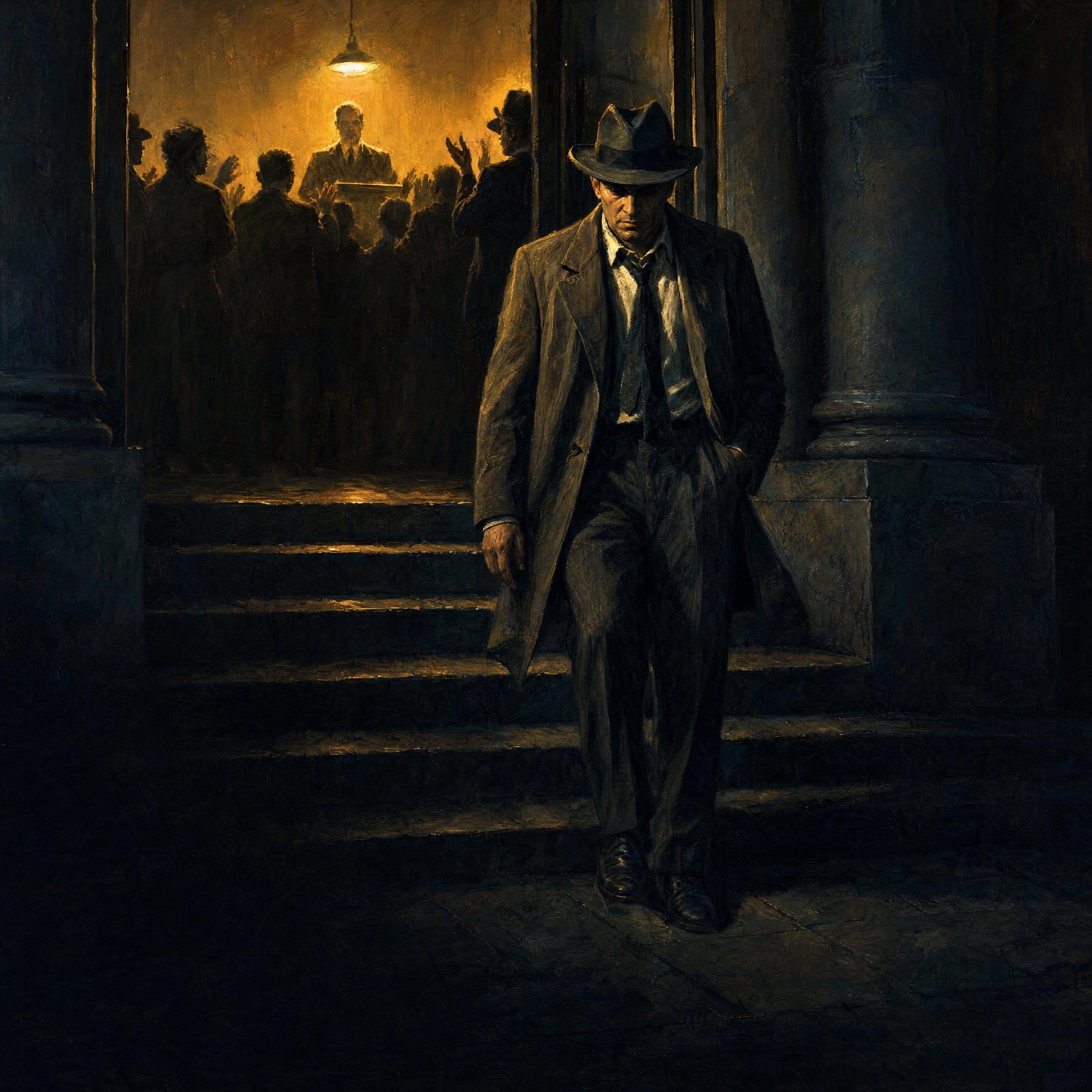
He walked out of that fire and let the name burn in it, and grew a soft voice and a bowed head and a story about a man who died young. And this afternoon a whole warm room rose up and clapped its hands for him — for the humble penitent, the reformed soul, the good man freely forgiven, no proof asked. I stood in the doorway and didn't clap. Because I'd finally done the one thing a forgiving room never does. I'd counted the doors.
Segment eight · Tastes Like Ash
The applause found me out on the steps, rolling through the open doors in waves and back out into a heat that gave every clap of it right back. I'd stopped just past the doorframe, close enough to hear them still on their feet for Merrit Vane. Dale was a step down with two paper cups of lemonade gone warm, because she keeps a sense for the afternoons I'll want my hands full of something that isn't a bottle.
There's the face. The one you get when you win and it doesn't help. Here. Drink the warm lemonade. It's honest, which is one more thing than anybody in that room can say.
Neva Dunmore killed the only man in there who was telling the truth. She confessed sitting up straight, proud of it. Crane's in the ground, she'll answer for him, and there isn't a crooked seam in any of it. Nobody innocent pays a nickel.
That's the worst kind, sunshine, and you know it. When it's dirty, you've got somewhere to put your hands. This one's clean all the way to the floor. The girl did it. She'll answer. No honest soul alive could stand up and call that wrong.
And that room in there forgave the one man who earned it least, and never asked him a single question to do it. Gave it away free. That's the part that keeps a person up nights.
That was the whole of it, and she'd set it down flat the way she does. A bought silence can crack, since a man who pays for his quiet lies awake owning the debt, waiting on the seam to show. But mercy handed over free asks nothing and never comes due, and there's no taking back what you gave for nothing at all. It was the softest thing that whole warm room had to give, and they had fitted it over the worst man in it like armor.
So here's the tab. You proved a good woman a killer, and you couldn't lay one finger on the man she believed in. That's what today cost you. Drink your lemonade before it turns to soup.
I didn't have anything to set on the counter against that, so I didn't try. I took the warm cup and went down the steps into the white afternoon, and behind me the doors stayed open and the clapping came out after me and wouldn't quit. There was a name freshly gilded into the cornerstone by the door, catching all that light. I didn't look at it. Some afternoons the win is real, the arithmetic all comes out even, and it still goes down like a mouthful of ash. I walked until the applause was only the heat again, and then I kept on walking.