




Five-Ten Out of Calloway Bay
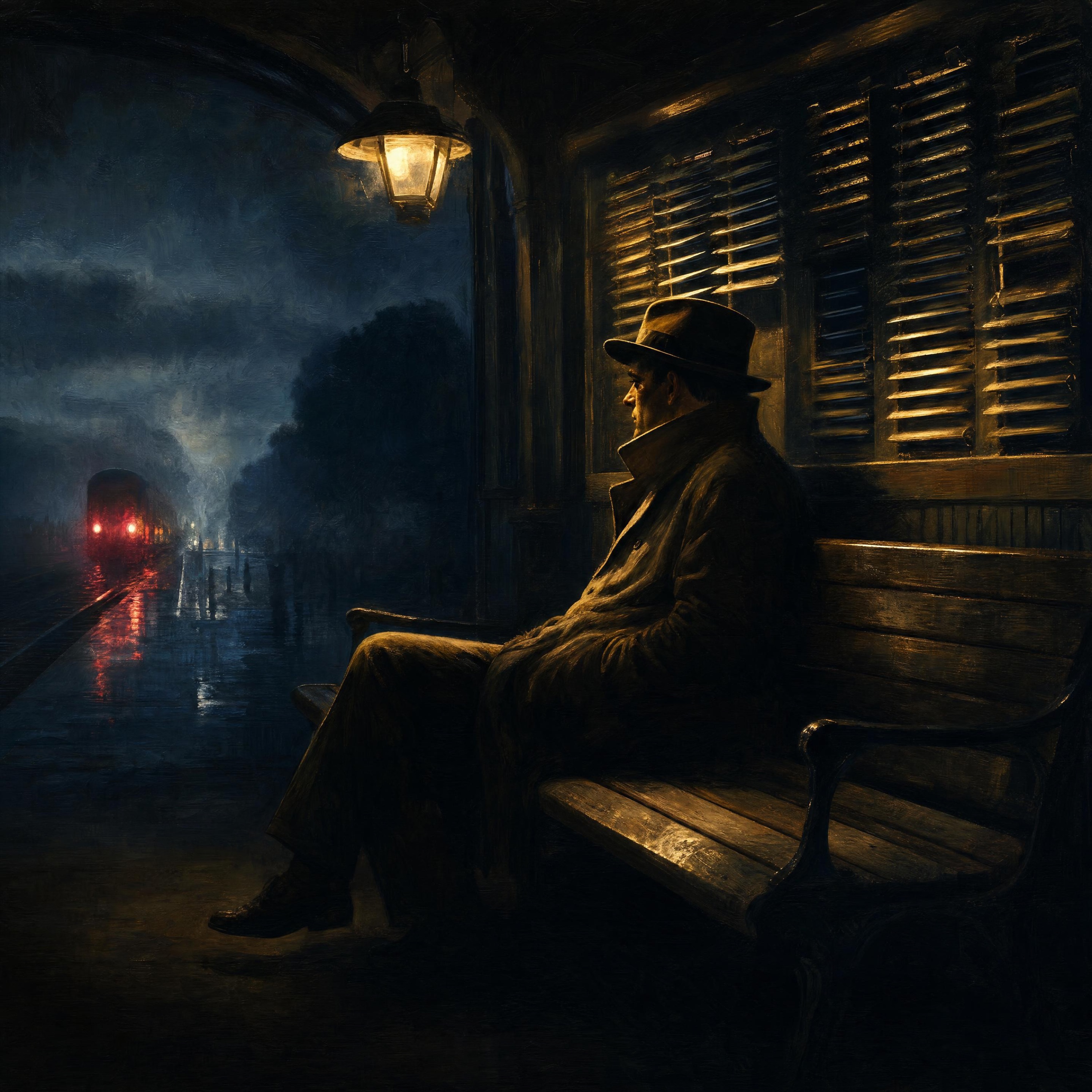
The clock reads a few hours to the 5:10 and Walter takes a bench facing the door, watching for a man he's sure is coming.
Pinned to the Corkboard and will not be contradicted by a later case.
Closed for good. The dead stay dead, and the canon is append-only.
Segment one · A One-Way Fare
One-way. The five-ten — the dawn bus, the interstate. However far it runs, that's where I'm going. Kell. Walter Kell.
Five-ten's the long haul. One-way's four dollars, fifty. Kell.
Take it. Take all of it, keep the change, I don't want it. Say — has anybody come by tonight? A man. Asking after Kell. Asking for me.
Mister, I sell fares. I don't keep a book on who's looking for who.
Right. Of course. It's only — I have to be on that bus. You understand me. I'm not coming back. Not to this city, not ever.
Most folks on the five-ten ain't coming back. Bench is over there. She loads at five.
Whatever a man walks in here and tells you about me — it's a lie. I never did the thing. I never signed for a nickel of it, you hear? I want that said. I never signed for a thing in my life.
And you're sure. Nobody's asked. You'd tell me — if somebody asked, you'd tell me.
I already told you what I do. I sell the fare, and I watch the clock. It's behind you on the wall if you want to watch it with me.
I didn't see any of that. I put it together later, the way you piece a broken glass back on the table after everybody's gone home — one shard at a time, and you always come up short one. But I know how it went in that depot. Walter Kell took a bench facing the door, four dollars of his last money folded into a one-way ticket, and he watched the wet street for a man he was dead certain was coming. The clock behind his head read a few hours shy of five-ten. He was right that somebody was coming. He was wrong about everything else.
Segment two · What She Found in the Lining
I found it sewn into the lining of his coat. Down in the hem, where he thought I'd never run my hand. A bus ticket. One-way. My husband's leaving me at dawn, mister, and he wrapped the goodbye up so careful I didn't even know that's what it was.
She came in a little after midnight, Ada Kell, with rain she hadn't bothered to shake off her shoulders and a stillness I'd seen on widows before there was ever a body. She wasn't a woman who cried easy. You could tell she'd spent all of that somewhere else, on some earlier night, and come to me with the account already empty.
He told me he loved me and to think well of him. That was the whole of it. Not where he was going. Not why. Just — think well of me, Ada, whatever they say.
Whatever who says?
That's what I came to ask you. I don't know. I've been married to Walter eleven years. He counts other men's money for a living and he's never taken a dollar that wasn't his. He's a good man. Whatever this is — he didn't do it.
Mrs. Kell, a man runs for one of two reasons. Something he did, or something he's afraid of. And sometimes the poor devil can't tell you himself which one it is.
Then get to him before that bus does. The five-ten, the dawn interstate. Stop him. Put him in front of me and let me look at his face. He'll come home if he sees me. I know my husband. He'll come home.
That's the stub. It's the only piece of him I've got left tonight. Bring me back the rest.
I get thirty a day, and my nights are usually my own. But your husband's got a clock on him now, Mrs. Kell. And starting the minute you walked in, so do I. I'll be at that depot before five.
She left the little stub on my blotter, face-up, four dollars and fifty cents of a whole man's future printed on cheap green stock. I looked at the clock on my own wall and did the arithmetic nobody in this business ever wants to do. Four hours, give or take, until the five-ten pulled out into the dark. And until it did, that ticket didn't belong to her, and it didn't belong to Walter. It belonged to me.
Segment three · Someone Came Before Me
The interstate depot at three in the morning is a church for people with nowhere left to pray. I came in off the wet street shaking the rain from my hat, and the night agent behind the cage looked up at me the way he looked up at the clock — because I was just one more thing in the room that wasn't five-ten yet.
Looking for a passenger. Name of Kell — Walter Kell. Thin fella, jumpy. Would've bought himself a one-way earlier tonight.
Five-ten. Paid cash, all of it, like the money was scalding his hand. Wouldn't even take his change.
He still here?
On the bench by the door. Hours now. Sits facing the street. Every time that door swings he near comes out of his skin — then it's just some sailor, and he sits himself back down.
He say anything to you? Ask you anything?
Asked me twice if anybody'd come by hunting him. Twice, same question. Funny thing, that.
Funny how?
Because somebody had. Hour before you walked in. Another fella — quiet, easy, asks me the same name. Kell, the five-ten. Didn't buy a fare, though. Just took a seat down the far end and settled in like he owned the night. Figured the two of 'em was traveling together.
Traveling together. I looked down the length of that depot — past Walter Kell flinching at his own shadow by the door, all the way to the dark end where a patient man sat with no ticket in his hand and all the time in the world in his lap. Whatever Walter thought he was running from, it hadn't chased him to this room. It had gotten here ahead of him, and it was waiting on the same bus. The clock on the wall let go of another minute toward five-ten, and I understood that my client wasn't the only appointment that was going to be kept tonight.
Segment four · Whose Debt It Was
You've been standing at that window an hour, sunshine, wearing a hole in the floor and what's left of my patience. The Kell woman's husband — you keep telling me he didn't do anything. So tell me the rest of it. What does a man run from that he didn't even do?
Dale had the lamp turned down low in the back room and a cup of coffee going cold at her elbow, because she'd stopped drinking it the second she got a good look at my face. She reads me better than any client ever paid to read a whole case. She was the only person left in the world who'd say the true thing straight at me and not flinch when it landed.
Walter Kell keeps ledgers. He's never in his life had a secret worth a bus ticket out of town. So it isn't his secret chasing him to that depot — it's somebody else's, come down on him. An old bill. And the collector finally found a door to knock on. His.
A bill that old doesn't just wander by itself into a stranger's coat pocket, Dale.
No. It gets put there. The only question is by who — and who let it sit unpaid long enough that it went out into this city looking for the wrong man to hand it to.
And there it was, the thing I'd been circling since midnight without letting my eyes come to rest on it. I pulled open the bottom drawer of the desk — not the one with the bottle, the other one, the one I keep locked for the things worse than whiskey. It was all still down there, right where I'd folded it away years back. An old wrong pressed small and flat, and under it a name I buried to keep a roof over somebody who is still walking around this town tonight, breathing free on my account. I never assigned that debt to a living soul. I just shut the drawer and let the guilt go begging.
It's mine, Dale. The thing running that poor clerk at a dawn bus — I put it in the ground years ago, and I never signed a name to it. So the city did that part for me. It went out hunting for somebody to pin the guilt on, and it stopped on Walter Kell for no reason on earth but that he was standing in the light.
So there's the price on the board tonight, plain as I can put it. A stranger's whole freedom — to keep a name you won't even say to me in an empty room. And you didn't choose it, sunshine. That's the ugly part. The city chose it for you, and it left you exactly one door out: turn it back on the one you buried it for. Ruin them, or let Walter ride.
He isn't who it's for, Dale. He's only where it came down.
Segment five · What Walter Knew
The Kell flat sat over a shuttered tailor's, three rooms and one window that looked at a brick wall, and the summer heat sat in them like a debt nobody would claim. Ada Kell opened the door on the chain, saw it was me, and let the chain fall. A woman who's stopped being afraid of strangers has usually found something worse to be afraid of.
You came back. I didn't figure you would, mister. Walter's not here. He hasn't slept here since Thursday, and I still make up his side of the bed. Habit, I suppose.
I know where he is, Mrs. Kell. What I don't have is why. A man doesn't buy a one-way seat on a dawn bus over nothing.
It wasn't nothing to him. Somebody came to the door. Tuesday, maybe Wednesday, the days run together now. I never saw the face. Walter took him out to the landing and shut the door on his own wife.
Did any of it come through the wall?
A name. Just the one, and I couldn't tell you whose. After that he wouldn't eat. He kept saying nobody believes an innocent man, that they'd lay the whole thing at his feet because he was the one still standing close enough to reach.
And there it was, the whole shape of it, laid out on a widow's kitchen table before she was a widow. The name she'd caught through the plaster wasn't a stranger's. It was a stone I'd dropped down a well a long time ago, and I had just heard it hit bottom in another man's life.
He didn't do a thing. Twelve years married, I'd know it on him. So you tell me, shamus. What does a man run from when his hands are clean?
From the kind of truth that doesn't much care whether they're clean. I'll be at the depot before the bus, Mrs. Kell. That part I can do.
She wanted the name. I'd been carrying it longer than she'd been married, and it would have fit in one breath. But some bills you signed so long ago the ink's gone brown, and you never once raised your hand to say the signature was yours. Walter Kell was about to pay mine. I stood in his front room, and I said nothing at all.
Segment six · Four in the Morning
Window's closed till the five-ten, friend. Coffee machine's been broke since Easter. You want a bench, help yourself. I got forty of 'em and one paying customer.
The depot ran on one bulb and a wall clock the size of a hubcap, and the clock had the only voice in the room worth listening to. Down the bench row a small man sat with a cardboard grip on his knees, watching the doors. And by those doors, not sitting, not buying, stood another man doing the same watching. Two men and a clock, all of them counting to the same number.
That clerk down the row. And the gent by the doors. They come in together?
Nothin' comes in together at this hour. Clerk's been here since midnight. Fella by the doors come in an hour back. Bought nothin', asked nothin'. Some men just like to stand where they can see a door.
You get a name off the clerk?
I sell seats, mister, not names. He wanted the five-ten, one way, cash. That's the whole of what I know about him, and it's already more than I know about you.
Years back a man I knew signed his name to a wrong and then had the decency to die before the note came due. That's the trouble with a debt in this town. It doesn't go in the ground with the man who made it. It waits in a drawer for the next warm body to walk past. Tonight the body was down the bench with a cardboard grip, and the drawer had always been mine.
There was exactly one way to lift the weight off him. Dig up the thing I'd buried and set it back down in front of the one I'd buried it for. Buy the stranger loose by burning somebody still breathing. I sat with that the way you sit with a bad tooth, and the clock kept right on counting.
Five-ten boards in a couple minutes. She leaves on time or she don't leave. Only thing left in this whole town that still runs on a schedule.
Five-ten! Interstate to Bakersfield and points east, now boarding, gate one. On time, folks. On time.
Segment seven · Nobody Believes a Clerk
You're the one Ada sent. I can see her in how you're standing. Don't sit down if you come to talk me off it, mister. I already paid for the seat. It's bought.
He was a small man gone gray at the edges, the kind who adds up other people's money all day and never once touches it. Out past the platform the five-ten sat breathing diesel into the dark, and Walter Kell watched it the way a man watches the last train out of a burning town.
I didn't come to talk you off anything. I came because you didn't do it. And because you and I both know that isn't going to save you.
That's it. That's the whole rotten joke of it. I didn't do one thing. And I sat up three nights and did the arithmetic, 'cause arithmetic's what I'm good for. Who believes a clerk? I got no name that carries any weight. They need a man to hang it on, and I'm the one standing closest to the peg.
The one who came to your door. He gave you a name.
Said it like I ought to know it. Said there was an old bill, and it had my number on it now. I never heard that name in my life, mister, I swear it to you. But you don't argue a thing like that. You just go find out what a one-way seat costs and you count out the fare.
I had the name he'd never heard. I could have laid it on the bench between us, and it would have pulled the peg out from under him and driven it clean through somebody else. Somebody still living. Somebody I'd spent years keeping off the books. The only word that could save this man was a name I'd sworn I would never say out loud, and I have kept worse promises for worse reasons.
If you know something. If you know one thing that helps, now's the time to spend it. That's my bus, mister. That's her, right there.
Go on. Get on the bus. Keep your head down past the county line, and don't ever write.
He picked up the cardboard grip and walked out under the gate light, an innocent man carrying a bill he'd never signed, and I let him carry it. The doors took him. The five-ten pulled out of Calloway Bay at ten past five, on the dot, the way the guilty things in this town never do.
Segment eight · The Six-Forty
Dawn came up gray over the harbor and found me on a bench that had a man on it an hour before and didn't now. The grip was gone. The seat still held the shape of him a while, the way a chair keeps you a minute after you've quit a room. Then it let that go too. Down the row the night agent stood at the board with a long pole, working the letters.
Still here, friend. Five-ten's forty miles gone by now.
Somewhere across town a woman was going to hear that the trail she'd hired me to follow went dead here, at a depot bench, and never got up again. That was the whole of what she'd ever get. I stood up.
She got out on time, then.
Everything leaves on time here. Only thing this town don't lie about.
The board clattered over its letters, and the five-ten folded itself away into the long row of things that had already left.
Six-forty next. Portland, Seattle, all the way up the coast. You buying, mister, or you just keeping my benches warm?